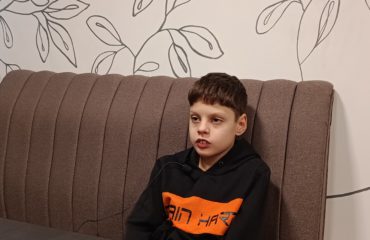
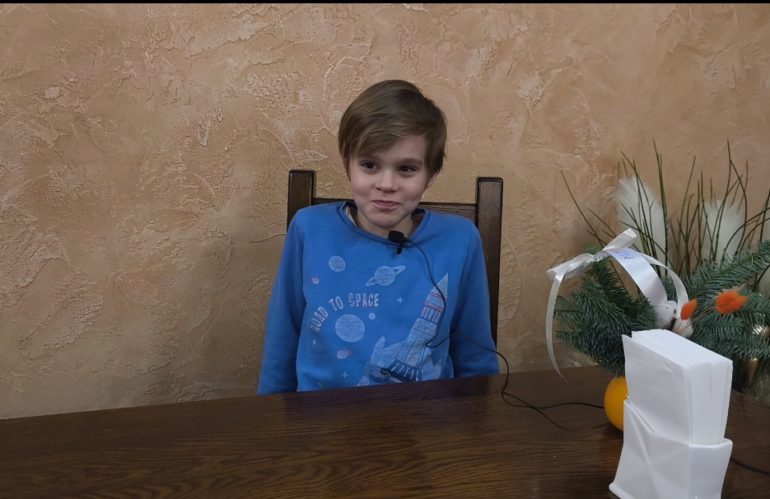
This is the story of a boy from Kharkiv who left the city at the age of four, barely remembers the road and the first days of the invasion, but clearly remembers his kindergarten friends, his apartment, a new school in Vinnytsia, the “Maiak” swimming pool, and record times in the 50-meter race. Around him is a large family, a younger sister, a baby brother, and parents who are building life from scratch in a new place.
🎥 Video Story
🟦 1. WHO IS OLEKSII
Oleksii is an 8-year-old boy who came to Vinnytsia from Kharkiv. He answers questions calmly and briefly, but behind these short answers lies the experience of displacement, life in a village, a new school, and serious involvement in sports.
💬 “My name is Oleksii, I’m eight years old. I came to Vinnytsia from Kharkiv.”
He does not remember the day the full-scale war began — at that time he was only four years old.
💬 “I don’t remember that day. I was four, I was still very little.”
🟩 2. KHARKIV BEFORE THE WAR: KINDERGARTEN AND THE APARTMENT
Before the war, Oleksii lived in Kharkiv and attended a large kindergarten near his home. He remembers this place and his friends well.
💬 “The kindergarten was big, and I had many friends. I lived not far from it.”
The family lived in an apartment where Oleksii had his own room, a bed, and toys.
💬 “We had an apartment. I remember my room, my bed, and my toys.”
There are many children in the family: an older brother, a middle brother, a younger sister, and now also the youngest baby brother.
💬 “There are five children in our family: an older brother, a middle brother, a younger sister, another little brother, and me.”
The newborn baby brother is named Adam.
💬 “I have a new little brother, his name is Adam. He is four months old, and I already love him.”
🟥 3. EVACUATION AND THE FIRST MONTHS IN A VILLAGE
The decision to leave Kharkiv was made by Oleksii’s parents. He does not remember that moment — for him it was more of a feeling: someone took his hand and brought him away.
💬 “I don’t remember them saying, ‘We are packing, we are leaving.’ I was small. They just took my hand and brought me.”
At first, the family did not live in Vinnytsia, but in a village in the Vinnytsia region — for about four months.
💬 “At first, we lived in a village for four months, and only then we came to Vinnytsia.”
🟧 4. A NEW LIFE IN VINNYTSIA AND SCHOOL
Oleksii arrived in Vinnytsia at about five years old. He really wanted to go to school — but because of his age, he was not yet accepted.
💬 “When we came to Vinnytsia, I was five. I wanted to go to school, but they didn’t accept me yet.”
Today he studies in the fourth grade at a large school in Vinnytsia.
💬 “My school is very big. I’m in the fourth grade, and we study on the first floor.”
He joined this class relatively recently — about three months ago — but has already found friends and adapted to the group.
💬 “I’ve been in this class for about three months. I like going to school.”
Offline learning is much more interesting for him than online classes.
💬 “I like studying offline. When there is no internet, online lessons just don’t happen — Zoom doesn’t work. But here I can see teachers and other children.”
🟦 5. FRIENDS AT SCHOOL AND BEYOND
Oleksii names his friends one by one: Dima, Yulia, Artem, and Solomiia. They are all about the same age.
💬 “My friends are Dima, Yulia, Artem, and Solomiia. Artem is eight, Yulia is eight, and Dima is nine.”
Most often they communicate at school, but sometimes they also meet outside of lessons.
💬 “We talk at school, and a few times we went for walks — once in the yard, and another time near the fountain.”
In his new class, Oleksii did not feel labeled as a “displaced child.” He says everything has been normal — both from teachers and other children.
💬 “I didn’t feel that I was treated as ‘not local.’ Everything is fine — from teachers and from children.”
🟪 6. SWIMMING — A HOBBY THAT BECAME AN ACHIEVEMENT
In Vinnytsia, Oleksii started swimming — not as a professional sport, but as a hobby that he really enjoys.
💬 “I don’t go to clubs, only to the swimming pool. Swimming is my hobby.”
He trains three times a week and has been doing so for about a year.
💬 “I train three times a week, for about a year already. In the group, I know the coach and the kids — everything there is good and joyful.”
At first, he simply wanted to learn how to swim — and he achieved that goal quite quickly.
💬 “I chose swimming because I wanted to learn how to swim. I learned in about three months.”
Today, Oleksii already has specific athletic achievements.
💬 “My record is 50 meters freestyle in 20 seconds. I took part in competitions — I have three first places and one certificate of appreciation.”
He is now mastering new swimming styles — backstroke and butterfly, which he explains in his own simple way:
💬 “I can also swim fast on my back, and now I’m training butterfly. It’s like a dolphin — more difficult technically and physically, but I can swim it.”
🟦 7. FAMILY AND EVERYDAY LIFE IN VINNYTSIA
In Vinnytsia, Oleksii’s family rents an apartment.
💬 “Now we live in Vinnytsia and rent an apartment.”
He has a younger sister, Mariia-Stefaniia, and a baby brother, Adam. His sister is four years old and attends dance classes, and with his baby brother Oleksii is learning to understand him “without words.”
💬 “My younger sister is four, her name is Mariia-Stefaniia. She goes to dance classes once a week. Adam is still very small — I understand his signals, when he wants to eat or when something is wrong, and then I call my mom.”
Oleksii helps at home — with younger siblings, homework, and daily tasks.
💬 “I help with homework, I can carry my younger brother, and help my mom when needed.”
His parents work: his father is a programmer, and his mother is a teacher who teaches adults online.
💬 “My mom works as a teacher and teaches adults online. My dad is a programmer — he makes programs and sits at the computer for a long time, sometimes half a day, until there is a result.”
Oleksii considers his father’s profession more authoritative — in a very childlike and honest way.
💬 “I think the programmer’s profession is more important because my dad earns more. But it’s a difficult job — you have to know math and computer science very well.”
🟨 8. GRANDPARENTS IN KHARKIV
Part of Oleksiy’s family remained in Kharkiv – his grandmother. Another grandmother lives in the occupied territory in the Kherson region, and there is no connection with her, his grandfather died before the war.
💬 “I have a grandmother and a grandfather, but they stayed in Kharkiv. My grandfather has passed away, and my grandmother is now in occupation. I can’t talk to her on the phone, but I miss her.”
His older brother moved to Slovakia, and Oleksii dreams of visiting him during school holidays.
💬 “My older brother moved to Slovakia. I’m not upset — I just want to visit him during the holidays.”
🟦 9. EMOTIONS, SADNESS, AND REACTIONS TO AIR RAID ALERTS
Oleksii sometimes feels sad, but finds it difficult to explain exactly when.
💬 “Yes, sometimes I feel sad, but I don’t remember exactly when. I don’t have any special secrets to deal with it — it just passes.”
He remembers his home in Kharkiv from time to time — more as a comparison with his new life in Vinnytsia.
💬 “Sometimes I remember my home. I mostly compare how it was at home and how it is here, in Vinnytsia.”
He reacts calmly and very maturely to air raid alerts.
💬 “When I hear an alert, I feel sad, but I just think that I need to go to a safe place. I don’t panic — I just go, because I know I need to be in a shelter.”
🟨 10. UKRAINE, PEACE, AND HEROES THROUGH OLEKSII’S EYES
When asked about victory, Oleksii says he does not know what it should look like. But he has a clear understanding of what peace means to him.
💬 “I don’t know what victory should look like. But peace is when Russia says that it attacked Ukraine first. Then peace will come.”
To the world, he would like to say a simple and very powerful phrase:
💬 “I would tell the world: don’t worry, peace will come soon.”
His heroes are Ukrainian soldiers.
💬 “Maybe I also want to say about heroes. For me, heroes are the soldiers who gave their lives to defend Ukraine. When I walk down the street and see soldiers, I look at them as heroes.”
After the war, he wants to return home — to Kharkiv.
💬 “After the war, I want to go back home, to Kharkiv.”
🟪 11. THE VOICE OF HIS MOTHER, OLENA
An important part of this story is the voice of Oleksii’s mother, Olena. She speaks about the decision to leave, responsibility for other children, the stress of evacuation, and how her son has changed.
💬 Olena, mother: “My name is Vertosenko Olena, the mother of Oleksii and Oleksandr. We came to Vinnytsia from Kharkiv at the beginning of the full-scale invasion. For the first ten days, we stayed in the basement of our building together with about 70 students who lived nearby without their parents. We felt responsible for protecting them. Only when the last student managed to leave Kharkiv did we decide to evacuate ourselves.”
She recalls packing in the first hours of the war — first of all, for the children.
💬 Olena, mother: “On February 24, at four in the morning, I heard explosions and saw ‘fireworks’ from our apartment window — those were strikes. I woke my husband; at first he didn’t believe it, but then he understood what was happening. I started packing things for the children: diapers, the most essential items. The older children packed their backpacks themselves, but mostly took sports clothes, so I had to add more necessities.”
The road out of Kharkiv was difficult and dangerous.
💬 Olena, mother: “It was impossible to get to the train station, so we left in our own car. We drove through the city and saw destroyed buildings and bodies of people. Then we transferred to a relative’s van and traveled to the Vinnytsia region that way. Traveling into the unknown with children is very hard.”
She speaks honestly about how children of different ages experienced the war, the basement, and displacement.
💬 Olena, mother: “The hardest time was for the older sons — ten and thirteen years old — they kept everything inside. The youngest daughter didn’t understand what ‘going home’ meant — for her, home is where we are now. Before the war, Oleksii was the happiest child in his kindergarten and loved going to his teacher Liuda. After the war started, he changed completely and became withdrawn.”
After moving to Vinnytsia, when local children returned to the courtyards, Oleksii experienced bullying.
💬 Olena, mother: “At first, we lived in a village, and it was calm. When we moved to Vinnytsia, local residents began returning in the autumn, and children appeared in the yard whom we hadn’t seen before. Some boys bullied Oleksii because he had arrived from elsewhere and even said that the war started because of him. He became even more withdrawn, and we had to turn to a psychologist and a psychiatrist.”
Live schooling and swimming became a major turning point.
💬 Olena, mother: “Oleksii finished first grade and almost all of second grade online at his Kharkiv school. Later, we managed to enroll him in a Vinnytsia school. Before the war, on February 24, he was supposed to go to his first swimming training session in Kharkiv, but it didn’t happen. In Vinnytsia, we didn’t find a swimming pool right away, but later we found ‘Maiak.’ The coach quickly found common ground with him, and he opened up. He won three first places in competitions — it supported him greatly.”
Despite the war and hardships, she speaks of children as the meaning and continuation of Ukraine.
💬 Olena, mother: “We decided to have another child already during the war, because life must go on now. As long as we have health and strength, we will give birth to Ukrainian children. This is our small contribution to ensuring that Ukraine remains Ukraine.”
To the world, she wants to speak about the strength of ordinary Ukrainians.
💬 Olena, mother: “Strong people live in Ukraine. Look at the social media pages of ordinary Ukrainians — we did not start this war, we are defending our land, and we simply want to live at home, so that our children attend Ukrainian schools and speak Ukrainian. Despite the war, we work, raise children, and try to live.”
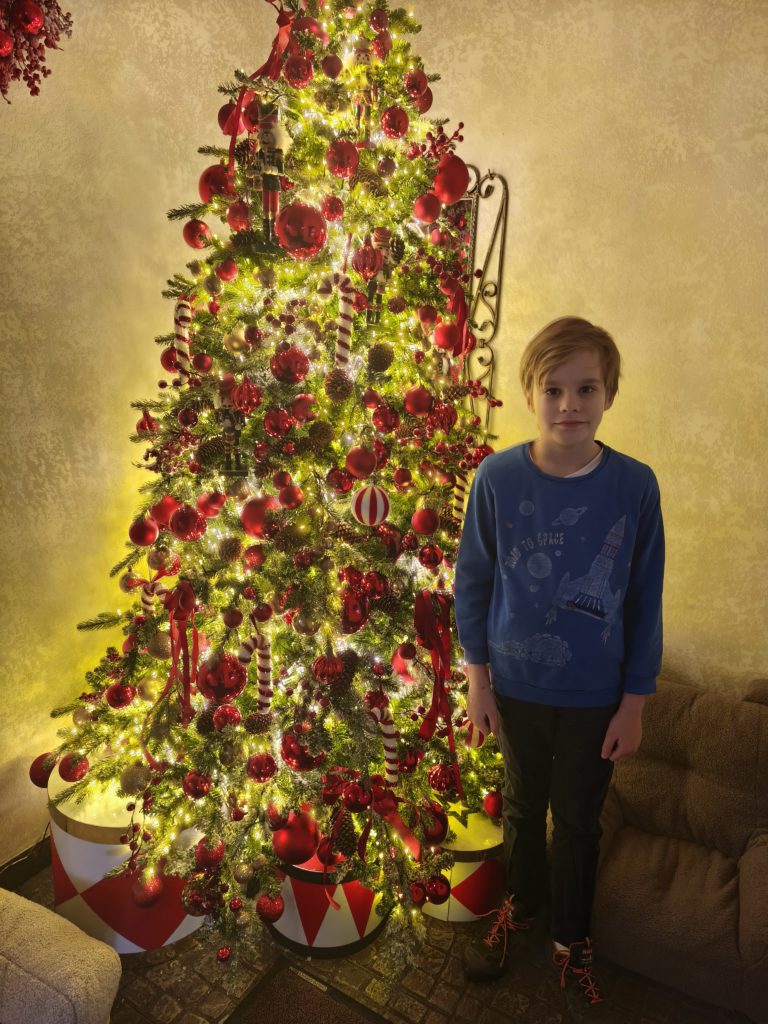
🟧 12. PHOTO GALLERY
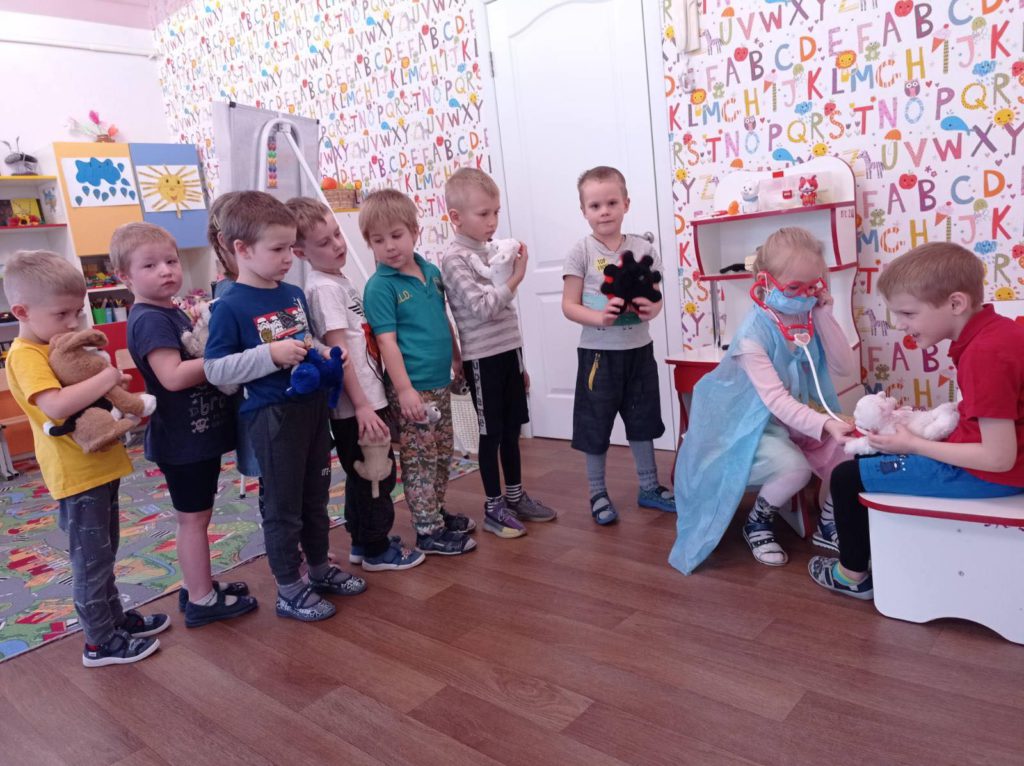
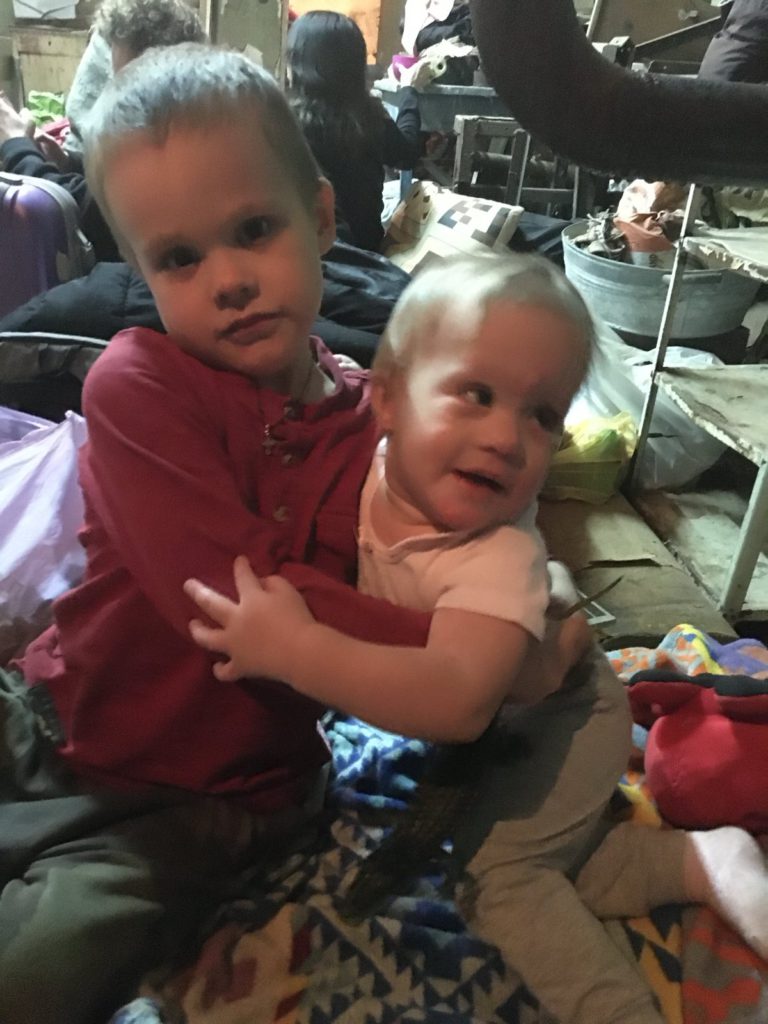
The survey was conducted by the NGO “Network of Civil Society Organizations Supporting Internally Displaced Persons in Ukraine” with the support of the Askold and Dir Foundation, administered by ISAR Ednannia, within the project “Strong Civil Society of Ukraine as a Driver of Reforms and Democracy,” funded by Norway and Sweden. The content of this publication is the sole responsibility of the NGO “Network of Civil Society Organizations Supporting Internally Displaced Persons in Ukraine” and does not necessarily reflect the views of the governments of Norway or Sweden, or of ISAR Ednannia.