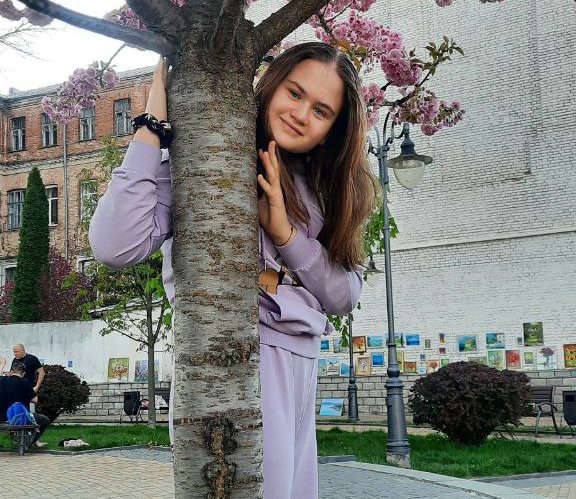
This is the story of a 15-year-old girl from Kherson who endured occupation and forced displacement across several countries, leaving her beloved cat behind. Despite hardships and bullying at a new school, she stood strong, found friends in Vinnytsia, and is rebuilding her life. Her journey is about loss, the struggle for acceptance, and a clear dream: a peaceful, restored Kherson where childhood can return.
🎥 Video Story
🟦 1. WHO IS ANASTASIIA
Anastasiia is a 15-year-old girl from Kherson. She currently lives in Vinnytsia, studies in the ninth grade, and is trying to build a new life far from her home, which ended up under occupation and shelling.
💬 “My name is Nastia, I am 15 years old. I was displaced from Kherson region, from the city of Kherson.”
🟩 2. KHerson BEFORE THE WAR: HOME, CAT, FRIENDS
Before the war, Kherson for Nastia meant a private house, a yard, friends nearby, and a cat she loved very much.
She and her friends didn’t meet often, communicating mostly online, but every meeting mattered. What she remembers most is the feeling of home — when everyone is close and everything is familiar.
💬 “Kherson for me is home, my cat, friends, and walks. We mostly communicated by messages and met rarely, but every meeting was important.”
She loved drawing and attended modern dance classes — her personal “territories of joy.”
💬 “I drew a lot at home and went to modern dance classes. That was what made me really happy before the war.”
🟥 3. THE START OF THE FULL-SCALE WAR AND OCCUPATION
When the full-scale war began, Nastia was transitioning to the sixth grade. At that time, school was already online due to quarantine, so learning formally continued — but now in an occupied city.
💬 “At that time, we were already studying online because of quarantine. I was moving to the sixth grade. Studying seemed to continue, but there was already war around, and the city was under occupation.”
Many of her friends left Ukraine. Today, she says, almost all the people closest to her from Kherson live abroad.
💬 “I still communicate with some friends — with some through video calls, with others by messages. But almost all my closest friends are now abroad.”
🟧 4. THE DECISION TO LEAVE AND SAYING GOODBYE TO HOME
The decision to leave Kherson was very difficult. They had very little time to pack — only two days. Living in a private house, they had to quickly decide what to take, knowing the separation from home could last a long time.
💬 “We had only two days to pack. We lived in a private house and took only the most necessary things and clothes because there was very little time. It was very hard to realize that we were leaving for a long time.”
The most painful moment was saying goodbye to her beloved cat. Nastia was afraid he wouldn’t survive such a long and difficult journey.
💬 “The hardest thing was leaving my cat. He is already six years old, and I was very afraid he wouldn’t handle such a journey. Neighbors are taking care of him now, but I constantly think about him and miss him.”
She admits that at least once a week she thinks about him and even looks up information on how she might one day bring him to live with her.
💬 “I think about him at least once a week and constantly search online for how animals can be transported, so that someday I can take him with me.”
🟦 5. A LONG JOURNEY: CRIMEA, RUSSIA, BELARUS
Because the Antonivskyi Bridge was destroyed, they couldn’t leave via the usual route. The road to safety went through Crimea, Russia, and Belarus — essentially making a long detour to return to Ukraine.
💬 “My mom and I traveled through Crimea, then through Russia and Belarus, because the Antonivskyi Bridge was destroyed, and we couldn’t leave normally. It was the only real route.”
The scariest memories for Nastia are from Crimea: the loud bridge, constant inspections, document checks, searches, and humiliation.
💬 “The scariest part was traveling through Crimea. The bridge was shaking, we were constantly checked, documents examined, belongings searched, and we were even insulted. It was very frightening.”
They didn’t travel alone — two acquaintances were with them, which gave some sense of support, though it didn’t remove the danger.
🟪 6. WHY THEY STAYED IN UKRAINE
The route through several countries made it possible to stay in Europe, but Nastia insisted on remaining in Ukraine — close to relatives and familiar people.
💬 “I really wanted to stay in Ukraine because our relatives and acquaintances are here. It was important for me to be close to my people.”
She honestly admits that at the time she barely knew English and didn’t feel she could protect herself in another country.
💬 “At that time, I barely knew English, and that scared me too. It felt like I wouldn’t be able to protect myself if something happened.”
Later, already in a safer place, her grandmother encouraged her to seriously start learning the language — another step in her growing up.
🟦 7. ZHYTOMYR, GRANDMOTHER, AND ONLINE SCHOOL
At first, she and her mother lived in Zhytomyr. Her grandmother evacuated separately and stayed in Kyiv for a while, and later the entire family ended up in Vinnytsia.
💬 “At first, my mom and I were in Zhytomyr, my grandmother came to Kyiv, and later we all ended up in Vinnytsia. Before moving to the new city, I studied online for some time at my Kherson school.”
Nastia admits that in Zhytomyr she didn’t really want to “put down roots” — it felt temporary, as if everyone would soon return home.
🟨 8. NEW LIFE IN VINNYTSIA: FIRST SCHOOL AND BULLYING
Her grandmother moved to Vinnytsia first — her choice became the reference point for Nastia and her mother. The city appealed to Nastia: it felt calmer and cozier.
💬 “My grandmother chose Vinnytsia first, and then my mom and I came too. I liked the city right away — it’s calmer, with places to walk and relax.”
The family now lives in a house and has been building a new life here for two years.
Her first offline school experience in Vinnytsia was very painful. At the first school, Nastia was not accepted by classmates — she openly talks about bullying because she was “not from Vinnytsia.”
💬 “In the first school, I couldn’t adapt at all. The children said I wasn’t from Vinnytsia, started humiliating me and calling me names. It hurt a lot.”
The homeroom teacher knew about the situation but didn’t intervene, which only deepened her sense of loneliness.
After transferring to another school, everything changed. Nastia found friends with whom she spends weekends, plays during breaks, and during air raid alerts they go to shelters together and watch funny videos to distract themselves.
💬 “In the second school, I like it already. I found friends, we walk together on weekends, play during breaks, and during alerts we go down to the basement and watch funny videos. There I was accepted completely differently.”
🟪 9. FRIENDS, CLUBS, AND LOSS OF MOTIVATION
From her previous class in Vinnytsia, she stayed in contact with only a few people, but in the new class she is gradually building new relationships.
She attends extracurricular clubs irregularly: sometimes she returns to drawing once or twice a week, sometimes plays volleyball, but often lacks energy and motivation.
💬 “Now I rarely go to clubs — sometimes I draw, sometimes volleyball. Honestly, motivation for studying and activities sometimes just disappears.”
Some subjects are particularly difficult, especially algebra.
💬 “The hardest subject for me is algebra — formulas are very difficult to understand.”
She has already thought about her future profession, but keeps it to herself for now.
💬 “I already have an idea of who I want to be, but for now it’s my little secret.”
🟦 10. LONGING FOR HOME, THE CAT, AND GROWING UP
Nastia doesn’t often talk directly about Kherson, but longing for home — and especially for her cat — is always present.
💬 “I rarely talk directly about Kherson, but the longing for home and friends never goes away. I want at least a little of that ‘native’ feeling — the people I grew up with.”
She now reacts to air raid alerts almost automatically — more like background noise, while following the news.
💬 “I don’t react to alerts as strongly as before — I mostly just check the news and see what’s happening.”
She feels she has grown up significantly over these years.
💬 “My thinking has changed. I became more serious and mentally stronger. I’ve been through a lot, and now I perceive problems differently — they no longer seem so trivial.”
🟨 11. FAMILY, GRANDMOTHER’S CAMOUFLAGE NETS, AND SMALL JOYS
Nastia is supported by her mother and grandmother. Her grandmother moved to Vinnytsia alone, without acquaintances, starting from scratch — and for almost two years now she has been weaving camouflage nets for the Ukrainian military.
💬 “My grandmother has been weaving camouflage nets for our soldiers in Vinnytsia for almost two years. She also started everything from scratch, without acquaintances, and now even does some small side jobs.”
Nastia helps at home — cleaning, walking the cat (now a local one), spending time with her mother. They like walking in parks and green areas, just to breathe fresh air and clear their heads.
💬 “I help at home — cleaning, walking the cat. My mom and I like walking in parks and green zones where we can calmly walk and rest.”
🟦 12. THE ARMED FORCES OF UKRAINE, DREAMS OF KHerson, AND ANASTASIIA’S VOICE FOR THE WORLD
For Nastia, the heroes are the Armed Forces of Ukraine.
💬 “For me, the main heroes are the Armed Forces of Ukraine. I wish them health, strength, and the fastest possible liberation of our regions.”
She dreams of a restored Kherson — beautiful, without destruction, without fear of shelling, without constant alerts.
💬 “I dream of seeing Kherson beautiful, without destruction and fear of shelling. I dream of returning home, of a city without alerts — then true peace will come for me.”
After the war, Nastia plans to continue her education in Vinnytsia, though she hasn’t yet decided where exactly, and at the same time thinks about how to begin rebuilding her hometown.
💬 “After the war, I want to continue my studies in Vinnytsia, and if I could, I would start rebuilding Kherson from the simplest things — cleaning the streets from shrapnel and mines so people can safely walk.”
She knows what demining is and is not afraid of conversations about weapons — she has already been shown different devices, which became part of her new reality.
Her message to the world is simple and honest:
💬 “I would like the world to help Ukraine more: donate for ammunition, weapons, and medicine for soldiers, especially on the front line. And to see us not only through war, but as a beautiful country with architecture and cities that should shine, not be destroyed.”
Her wish for Ukrainian children and families:
💬 “I want to wish children to study more, because they are our future. And adults — to support each other. Unity is very important now, and then victory will be closer.”
She believes in the power of voice — even through posts in English, so the world can see and hear Ukraine.
💬 “Even by simply publishing information in English, we can show the world that it is hard for us and ask for support for Ukraine.”
🟧 13. PHOTO GALLERY
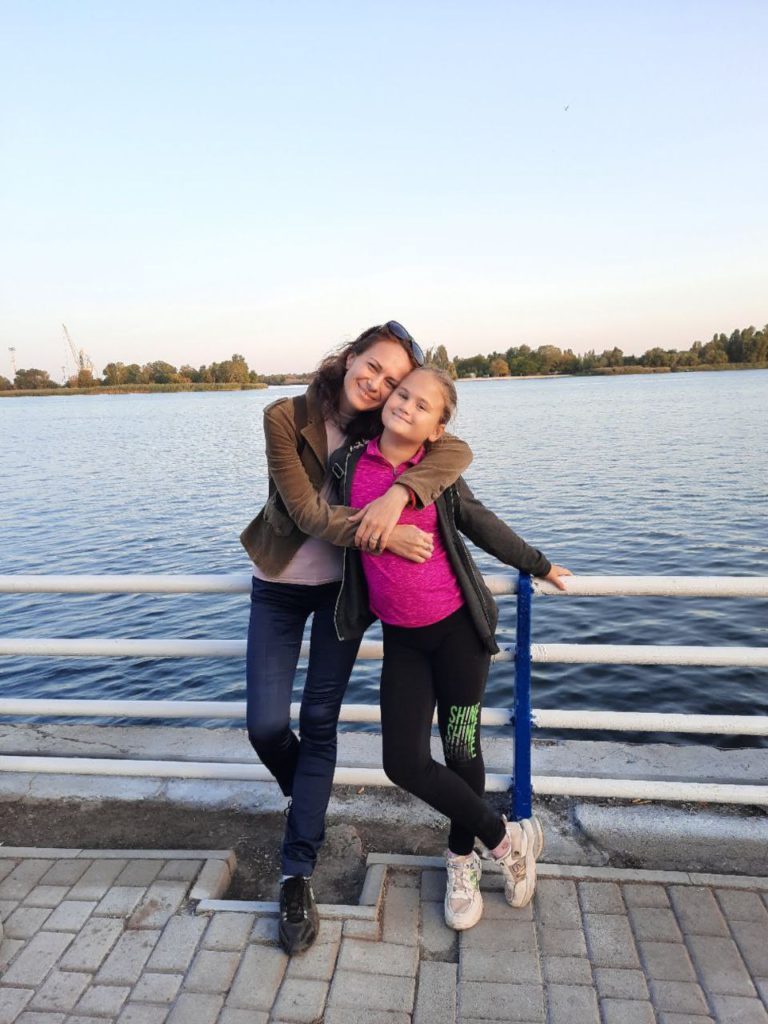
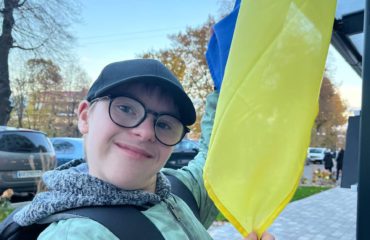
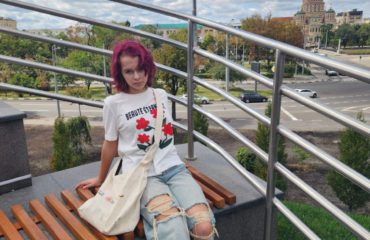
This is Kherson, Anastasiia’s native city. Here, she was a happy child who believed that peace was forever.
A hug with her mother preserves the memories of a home she had to leave — but never stopped loving.

This photo is a memory of Kherson under occupation.
Her mother is beside her — and sometimes, that’s all it takes to survive even in the darkness of war.
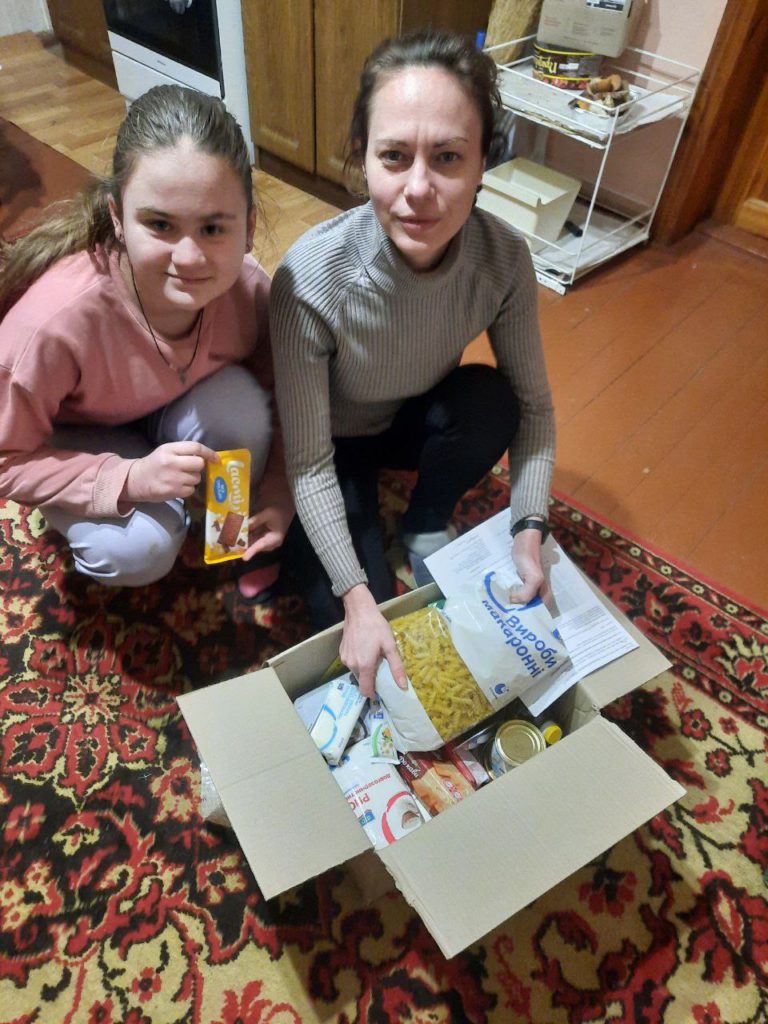
The value of simple things has grown a thousandfold.
Anastasiia knows well what it means to be grateful for every grain of support.
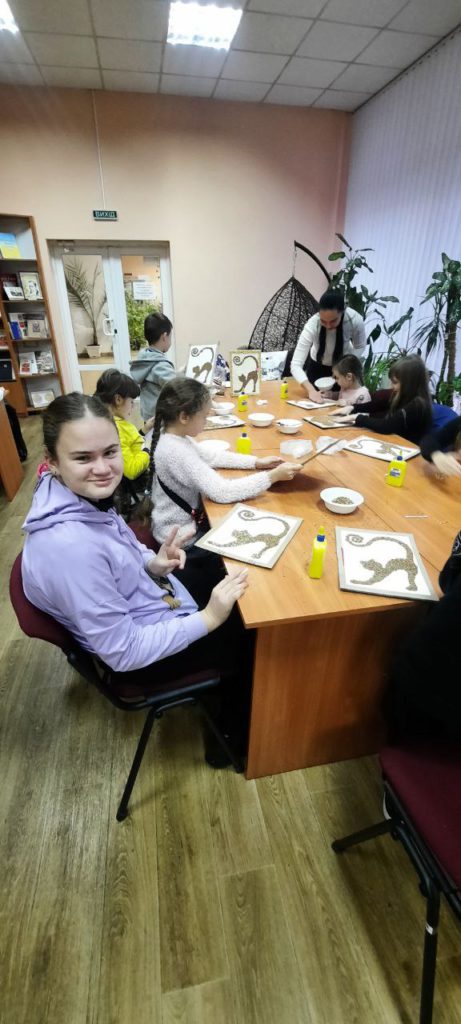
In the library, among other children of war, she draws again.
This time — not with paint, but with grains. And each grain speaks of hope.
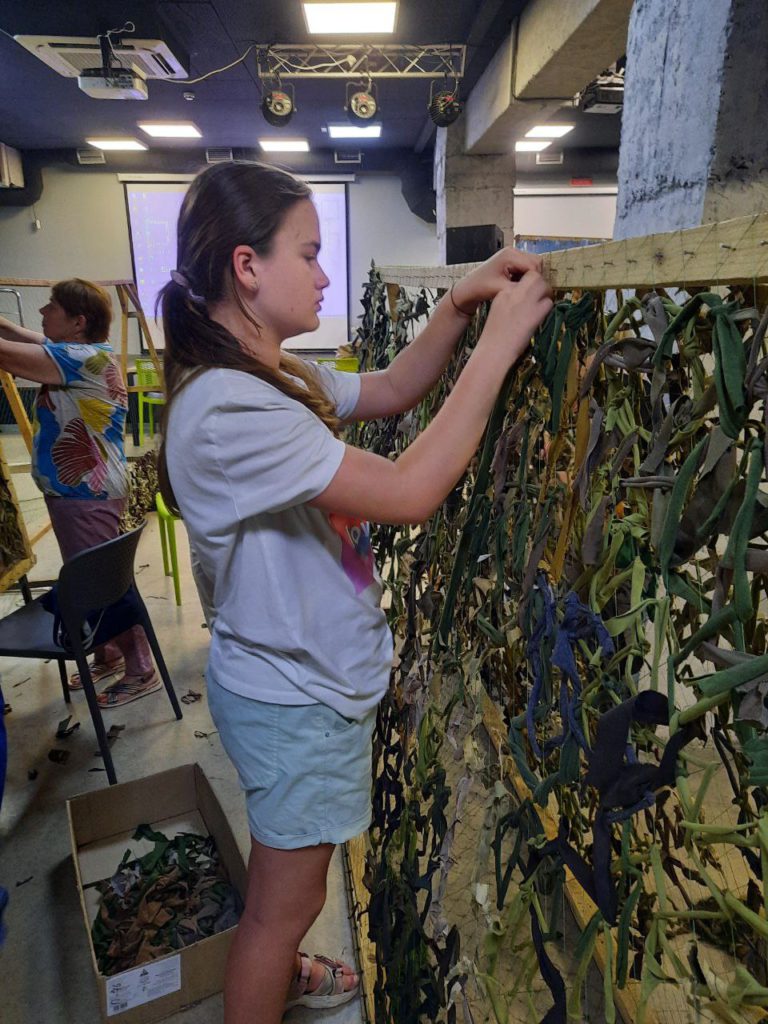
Her hands are still those of a child, but the tasks are adult ones.
She helps the front, weaving not only fabric strips, but also her belief in Victory.

She is learning to rejoice in spring again — after losing her home, her beloved cat, and her friends.
The smile in this photo is no longer a child’s, but it still shines.
The survey was conducted by the NGO “Network of Civil Society Organizations Supporting Internally Displaced Persons in Ukraine” with the support of the Askold and Dir Foundation, administered by ISAR Ednannia, within the project “Strong Civil Society of Ukraine as a Driver of Reforms and Democracy,” funded by Norway and Sweden. The content of this publication is the sole responsibility of the NGO “Network of Civil Society Organizations Supporting Internally Displaced Persons in Ukraine” and does not necessarily reflect the views of the governments of Norway or Sweden, or of ISAR Ednannia.